My Homepage

Monday, October 31, 2016

The Benefits for Financing Down Payments and Renovations

 Written by Rebecca Kennedy


Whether you're a professional property developer or a single homeowner, financing your property ambitions comes above all else. Even professional property developers with a proven system of acquiring and renovating homes, condominiums and business properties can run into financing issues.


We've examined the benefits of financing a higher down payment, purchasing renovations and the cash financing options available for those of you looking to buy and upgrade your home.


Why Save For a Greater Down Payment?

Banks and lenders want low risk scenarios and that ultimately comes down to meeting the required down payment for your mortgage deal, and they'll give you a better deal if you offer a lower risk scenario. Paying an increased down payment comes with a number of fantastic benefits for your financial future. Here's a few key benefits, according to Investopedia;


Reduced Mortgage Payments - Because you've put more cash up front, your monthly payments will be smaller and more manageable


Lower Interest Rates - Lenders will give you a far improved rate since you're deemed a lower risk. Expect interest rates to lower significantly upon 20% down payment.


No Mortgage Insurance Fees - If you can't afford a significant deposit, most mortgage deals will require you to take out mortgage insurance, which will add another 0.5 - 1% interest on top of your existing deal.


Ability to Ride Out Financial Crises - When it comes to a financial crisis, those in most danger of ruin are the ones who have taken out the maximum loan available on the lowest down payment. They have a high interest rate deal and may even face foreclosure.


Why Save For Renovations?


Renovations and upgrades obviously provide that wonderful ability of allowing you to transform your new home into your own dream living space. But aside from that, they can also allow you to significantly improve your home's resale value. Investopedia strongly advise making wise additions to your home that will ultimately boost your bottom line.


According to US News Money, these are the renovations and replacements that will bring the greatest % return on investment;


Renovations that bring the greatest percentage return on investment:
  • Entry door replacement: 96.6%
  • Deck addition (wood): 87.4%
  • Attic bedroom: 84.3%
  • Garage door replacement: 83.7%
  • Minor kitchen remodel: 82.7%
Renovations that yield the smallest return:
  • Home office remodel: 48.9%
  • Sunroom addition: 51.7%
  • Bathroom addition: 60.1%
  • Backup power generation: 67.5%
  • Master suite addition: 67.5%
Financing Options


So now you understand some of the reasons for actually spending more cash on your home! But if you don't have a large disposable income, you may need to find a means of financing your purchases.


Saving - Of course, the glaringly obvious method for saving a down payment isn't so straight forward. That's especially true if you've got student debt, rental payments and bills to pay, with very little disposable income to go towards your downpayment. The internet is a wonderful place however, and fortunately there's a number of down payment saving strategies to help you!


Help from your parents & family - It's the go to option for many first time home buyers. Loving parents are willing and often able to give you that extra boost in disposable income necessary to make that all important down payment on your first home. Even if you can agree a repayment plan with them, that's going to be far more favourable than turning to a personal loan for financial assistance.


Personal loans - There's a number of reasonable options for taking out a personal loan - Peer-to-peer lending platforms, car title loans (see how car title loans work) and credit cards are just some of your options for accessing cash.


Tap your IRA - There's an exemption for withdrawing up to $10,000 from your IRA for the purpose funding your first home. It's an initiative you should consider if you've got money built up!


Hustle - Whether it's getting a second job or selling off your unwanted possessions on Ebay and Craigslist, there's nothing like a bit of hustle to increase your bank balance and put you in a more financially secure situation.


Whatever you decide, ensure that you're in a stable situation to make the commitment of purchasing property. After all, the 2008 financial crash was a stark reminder that the property market can be a fickle one.

All the single ladies are shaking up this real estate market

Gayane Meschyan is taking her time shopping — she expects to own this next purchase for at least 10 years.

At age 43, with no spouse or children, she wants to feel sure she's making the right choice.


"I see it as security. It's an investment, and I want to build wealth," said Meschyan. "You think you know the future, but you don't. You can't fully predict the future, so the best you can do is plan for it."


Meschyan, who has a Ph.D. in psychology and works as a research analyst for Los Angeles County, is shopping for a single-family home. She already owns a condominium in Burbank, but said she feels like she's outgrown it. She plans to keep the condo, which is in a building, for rental income, and buy the single-family home to live in.


A real estate agent shows a home for sale to a prospective buyer in Miami.

"My main motivation is because you don't have anyone above you, you have more of a sense of peace," she added.


Meschyan is one of a growing number of single women buying homes. In the past year, single women made up 17 percent of all homebuyers, purchasing at twice the rate of single men, according to a new annual report from the National Association of Realtors. This, despite the fact that women have much lower average incomes than men. Like men, three-quarters of the properties the women buy are single-family, detached homes.


"Single women for years have indicated a strong desire to own a home of their own, as well as an inclination to live closer to friends and family," said Lawrence Yun, chief economist for the NAR.


"With job growth holding steady and credit conditions becoming somewhat less stringent than in past years, the willingness and opportunity to buy is becoming more feasible for many single women."


Barbara Jennai, 68, already lived close to her daughters — a little too close after a while. She was living with them, helping to raise her grandchildren. With the kids older now, Jennai felt it was time for her to move out on her own. She rented for a while at Leisure World of Maryland, an active adult community, but a few months ago she decided to buy.


"When I rented I wasn't really putting away any money. A lady in my building said there is such a thing as a reverse mortgage. She connected me with a lender and it turned out that I was a perfect candidate," said Jennai.


Jennai still works full time as a special education teacher, but she was putting far too much of her salary into rent. She had enough savings to make the down payment on the mortgage, and now her monthly payments are less than one-third of her former rent. She also likes the idea of being an owner.


"It's the first time in my life I've ever owned. I walk in every day and say, 'Hello beautiful home,' because it's mine. It's really a wonderful feeling and a feeling I've never had before," said Jennai.

As women move ahead in the workplace, commanding larger salaries, it just makes sense they would start buying more homes. Much of the buying, however, is by older women. That could just be part of the trend of downsizing baby boomers.


"They're either divorced or their husbands have died, and they have the money and they're buying," said Jane Fairweather, a real estate agent in Bethesda, Maryland. "They want stability. They want to have control over their monthly expenses. They're going to be where their children or friends are. They're not whimsical at that age."


Fairweather said she does not see a lot of young women, millennials, rushing in to buy homes, but that may be a factor of the high-priced neighborhood in which she works. Other agents say they are seeing more young women buy, although they usually start with condominiums in full-service buildings for a higher sense of safety.


In the past, single women often had harder times qualifying for mortgages than men. They might have to have a parent co-sign the loan. Those days appear to be over. Said she had no trouble at all getting her home loan.


"My Fico score is over 800. My adult report card is really high," joked Meschyan. "I invested in mutual funds, and the money grew. I've saved regularly. That's what's helped me."

Wednesday, October 26, 2016

New-Home Sales Decline, but So Do Their Prices

| Sep 26, 2016
Prices and sales of brand-new abodes, with all those gleaming appliances and immaculate floors, slid in August as buyers’ mad rush of recent months to close on the homes of their dreams began to wane.


Despite falling prices, new-home sales dropped nearly 12.3%, to about 50,000 purchases nationwide, from July to August, according to the U.S. Department of Commerce’s monthly residential construction report. But they were up almost 22% from the same month a year prior.


The numbers cited above were not seasonally adjusted. That means they weren’t smoothed out over 12 months to account for the ups and downs of the housing market.


A drop in sales in August is typical, as it takes about six months after buyers sign on the dotted line before their residences are completed, says realtor.com®‘s chief economist, Jonathan Smoke. And in much of the country, folks don’t want to be unloading all their worldly goods into their new homes in February, one of the coldest months of the year.


But of those properties that did go under contract, more were priced for the budgets of first-time buyers. The median price tag of a new home dropped to $284,000 in August, according to the report. It was down 3.1% from July and represented a nearly 5.4% decrease from the same time a year earlier.


Sales of homes under $150,000 were up 50% in August both monthly and annually, according to the report. But at just 3,000 buyers signing on the dotted line, they made up only about 6% of sales.


“That’s a reflection of builders catering to more first-time buyers,” says Smoke. “It shows that most of the increase in sales going forward are more likely to be coming from new homes.”


The reason for that is simple: There just aren’t enough existing homes (those previously lived in) for sale. Homeowners have been reluctant to sell because, in turn, there aren’t enough trade-up residences for sale that they can afford, he says.


The median cost of an existing home was $240,200 in August, according to the National Association of Realtors®.


However, buyers on a budget looking for either an existing or a new home may have had a harder time scoring a recently constructed abode in the $150,000 to $199,999 range. Sales of those properties were down 33.3%, hitting 6,000, from July, according to the Department of Commerce report. There were roughly the same number of purchases in August 2015.


The bulk of the sales of new residences, about 19,000, were in the $200,000 to $299,999 range.


Just 2,000 homes with price tags of $750,000 or higher were sold in August—down 33.3% from July, according to the report. The same number of homes were sold in August 2015.

The Mysterious Disappearance of Repeat Home Buyers

| Sep 26, 2016
A lot of ink has been spilled over the woes of first-time home buyers struggling to save up for a down payment while paying off student loan debt, securing a mortgage in an age of sky-high credit scores, and then finding an abode they can afford at a time when the lack of properties on the market is driving prices to new heights.


But what about repeat home buyers—folks who already own the roofs over their heads, but want to trade up for a bigger residence or move to a new location? They haven’t exactly been faring too well either.


In fact, there were about half as many second- or even third- or fourth-time buyers in 2015 as there were in 2001, according to a recent report from the Housing Finance Policy Center at the Urban Institute, a Washington, DC–based think tank.


In 2001, there were about 1.8 million repeat buyers. That number sank to nearly 630,000 at its lowest point, in 2011, before beginning to rebound the following year. There were just over 931,000 sales to second-time buyers in 2015.


The study looked only at Fannie Mae, Freddie Mac, and Federal Housing Administration loans from 2001 through 2015 data. Mortgages made by private lenders and banks were not included.


“We’re going in the right direction,” says Sheryl Pardo, spokeswoman for the center at the Urban Institute. But “the postcrisis depreciation in home values hit repeat home buyers [hard].”


The average loan size of these repeat buyers was $246,166, according to the report.


One possible culprit for the drop-off was that many homeowners lost equity in their homes when the housing bubble burst starting in 2007. That meant they couldn’t convert that equity into a down payment for a bigger and better home, she says.


And those who lost their residences to foreclosure will have a tougher time getting a mortgage for a new property. Lenders are typically reluctant to issue loans to those who have gone through a foreclosure in the past seven years.


Even current homeowners who bought before the housing crisis may have trouble getting a loan on a new home these days—credit requirements are simply tighter in the aftermath of the housing bust
.
Another problem is that those fancier and more spacious homes cost more. And there simply aren’t enough residences for sale to satiate demand.


“It’s too expensive to move up,” says Gerd-Ulf Krueger, chief economist at Krueger Economics, a housing data firm based in Los Angeles. “The people who want to trade up aren’t putting their homes on the market, because they aren’t seeing enough alternative properties that are attractive to them at the right price.”


He expects that the number of homeowners buying new abodes will rise—but not by much.
“There’s just not enough [residences] on the market. There’s not enough new home construction,” Krueger says. Builders are “trending toward more upscale markets, and there’s something missing in the middle.”

4 money tips for new homeowners


More than 60% of Americans own their homes, and while there are certain benefits to ownership, there's also a downside: the cost.


You may have thought that coming up with a down payment was the greatest financial hurdle you'd face, but as you'll soon come to learn, there are numerous expenses associated with owning a home. Here's how to handle them.
  
1. Create a new budget


Given that your monthly mortgage payment is bound to differ from your previous rent payment, it might seem like a no-brainer that you'll need to adjust your budget accordingly. But there's more to it than that, because you may find that other costs change by virtue of your new home. For example, if you move from a two-room apartment to a 2,000-square-foot house, you can bet on your heating and electricity costs going up.


Similarly, if you suddenly have a lawn to maintain, you can expect to spend more than you would renting an apartment.


Rather than just substituting your new mortgage payment for your previous rent payment, spend a few months tracking all of your expenses and update your budget to reflect the actual costs of living in your new home. You may come to find that you're spending more than expected, in which case you'll need to adjust your flexible expense categories, like leisure, to compensate.


2. Prepare to spend money on repairs and maintenance


You're probably aware that you'll spend some money on maintenance and repairs for your home, but you may not realize just how much you may end up parting with. Most homeowners spend 1% to 4% of their homes' value each year on repairs and maintenance.


So if your home is worth $300,000, expect to shell out anywhere from $3,000 to $12,000 a year on upkeep. And if you need to do something major, like replace a faulty heating system or roof, your costs could climb even higher.


You should therefore aim to pad your emergency savings so that you have funds to tap if a significant repair pops up unexpectedly. Most people need at least three months' worth of living expenses in an emergency fund, but as a homeowner, you should aim for six months' worth of expenses or more.

3. Expect your property taxes to go up


Your property taxes are based on the assessed value of your home coupled with local tax rates. When you buy a new home, you'll be advised of your current property tax liability -- but don't get too comfortable with that number.


Property taxes have a tendency to rise, even when home values drop. Back in 2000, localities across the U.S. collected an estimated $247 billion in property taxes, but by 2010, that number almost doubled to $476 billion despite the decline in home prices from the infamous housing bubble implosion.


Additionally, some localities require property reassessments at certain intervals (such as every year, every other year, or every three years). If your home is reassessed at a higher amount, you could see an instant hike in taxes.


To protect yourself, leave some wiggle room in your budget. This way, if you're hit with a significant property tax increase from one year to the next, you won't be scrambling as much to make those payments.


4. Don't get caught off guard when big payments come due


Some people roll their homeowners' insurance and property taxes into their mortgage payments via an escrow system. The way this works is that a lender will charge a set amount each month above your mortgage payment alone, put that excess money in an escrow account, and use it to pay your property taxes and homeowners' insurance for you. But not all mortgages work this way. Many just have you make your exact mortgage payment and remain responsible for paying your homeowners' insurance and property taxes on your own.


If you fall into the latter category, you'll need to budget accordingly so you're not caught off guard when these larger payments roll around.


The average U.S. household spends $2,127 on property taxes each year, but in many states, that number is much higher. Take New Jersey, for example, whose average annual property taxes exceed $7,000 and, in some counties, can easily top the $15,000 mark.


Most homeowners pay property taxes quarterly, and if yours are $4,000 a year, that's an extra $1,000 check you'll need to write every three months. Rather than scramble to come up with that money, be sure to budget $333 a month for property taxes. Along these lines, the average annual homeowners' insurance premium in the U.S. is $952. If you're required to make that payment all at once, you'll need to set aside money each month in anticipation.

Thursday, October 20, 2016

First-Time Millennial Buyers Poised to Revolutionize the Real Estate Market in 2017


| Oct 19, 2016

             
You want a real estate revolution? We’ve got you covered: Next year, more than half of all homes will be bought by first-time home buyers, according to an exclusive survey of buyers by realtor.com®. It’s a seismic shift from 2016. And here’s the kicker: Most of those newbies will be millennials.

Get ready for a new-look housing market.


Each year, realtor.com®  does an annual survey of home shoppers to get to the heart of home-buying trends. And what we found this year is a true sea change in the buying population that will affect which homes and neighborhoods are the most desirable in 2017.


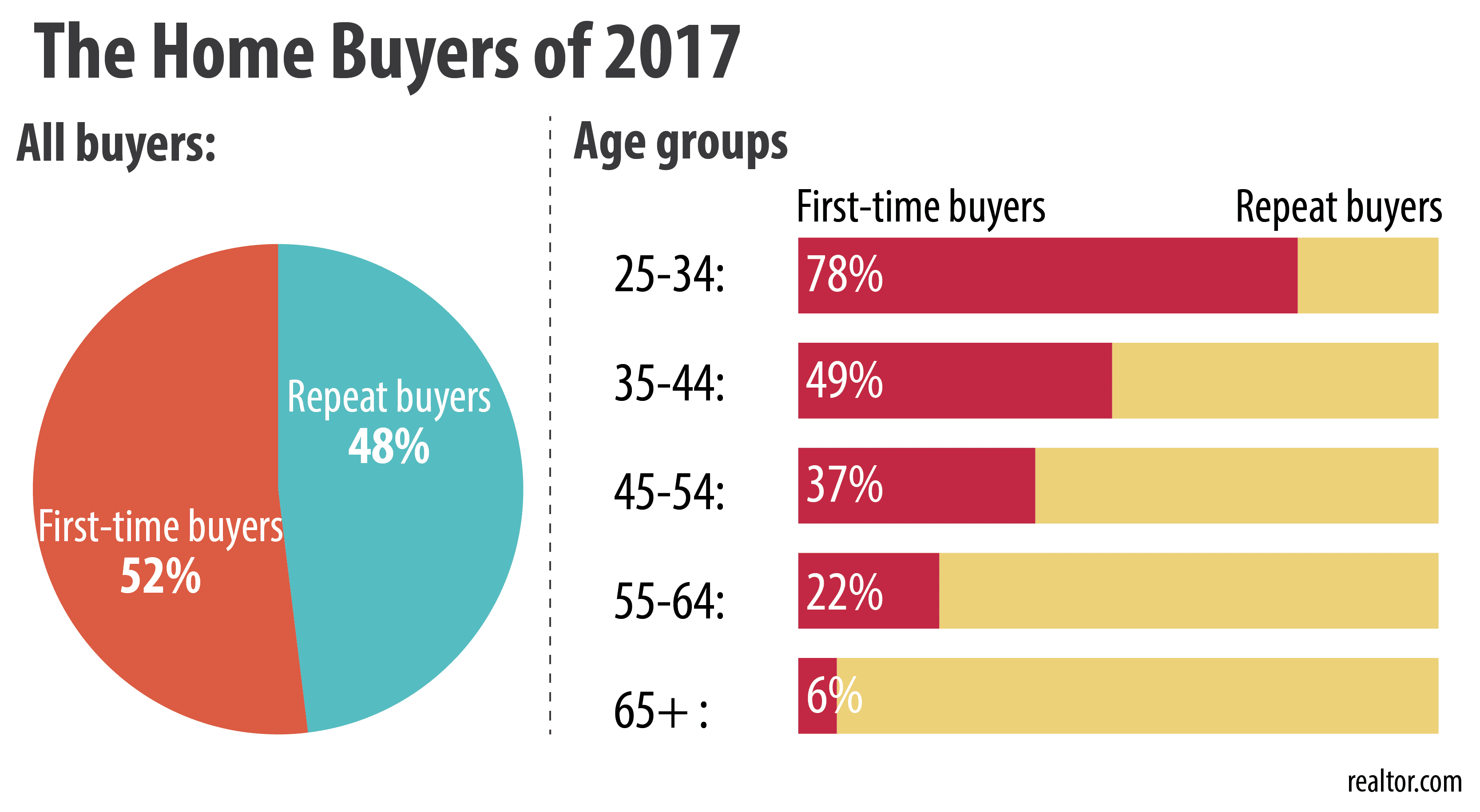
In sharp contrast with 2016, when only 33% of people planning to buy a home were first-time buyers, 52% of buyers with their eye on a home purchase next year will be first-timers. And 61% of those are under age 35.


“This represents an ‘Oh, shift’ moment in housing,” says Jonathan Smoke, chief economist for realtor.com®. Smoke’s team analyzed responses from active shoppers on our site who plan to buy a home in the spring or summer of 2017. “With so many first-time buyers in the market, competition will be even fiercer next year for affordable starter homes in the suburbs. Those looking to buy may want to consider a winter home purchase in order to avoid bidding wars and higher prices spurred by a potential increase in millennial buyers.”


shopper-01

What motivates—and scares—millennial buyers

Although a shortage of homes for sale will continue to dog the market, first-time buyers are more worried about financial issues, according to the survey. Topping the list: coming up with a down payment (37%) and finding a home within their budget (30%). With all the emphasis on financial issues, millennial buyers want to make sure that their money is well spent: Making a sound financial investment is a top goal.


This new generation of first-time home buyers is focused on safety, privacy, and more space, indoors and out. That’s because millennials’ top reasons for buying a home are that they’re getting married or moving in with a partner, growing tired of their current living space, or planning a lil’ addition to the family. Or perhaps all three!


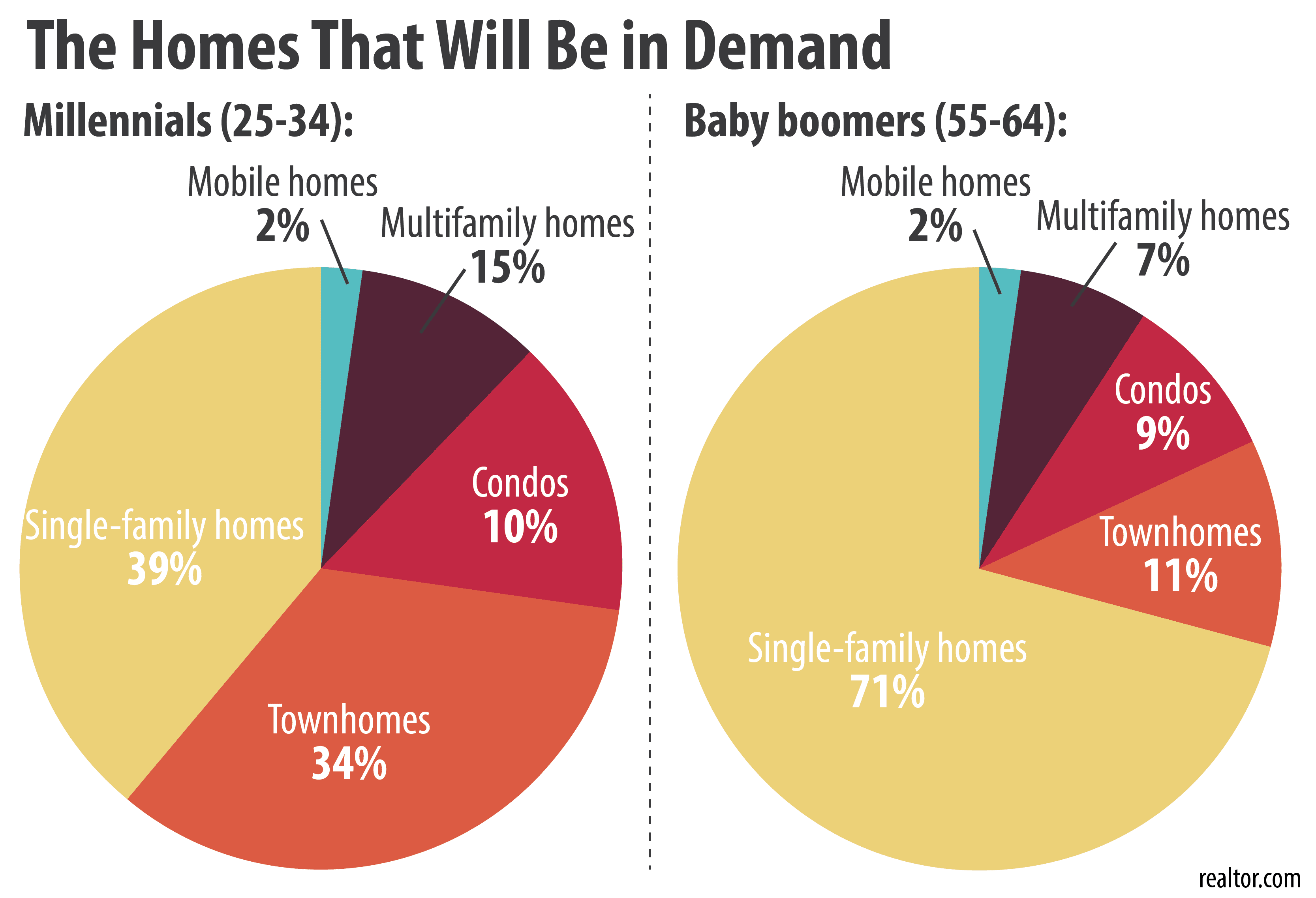
So it’s no wonder that millennial buyers prefer single-family homes (39%) or townhomes (34%). Just 15% are interested in multifamily homes, and 10% in condos.


shopper-02

Suburbs appeal to millennials and boomers alike

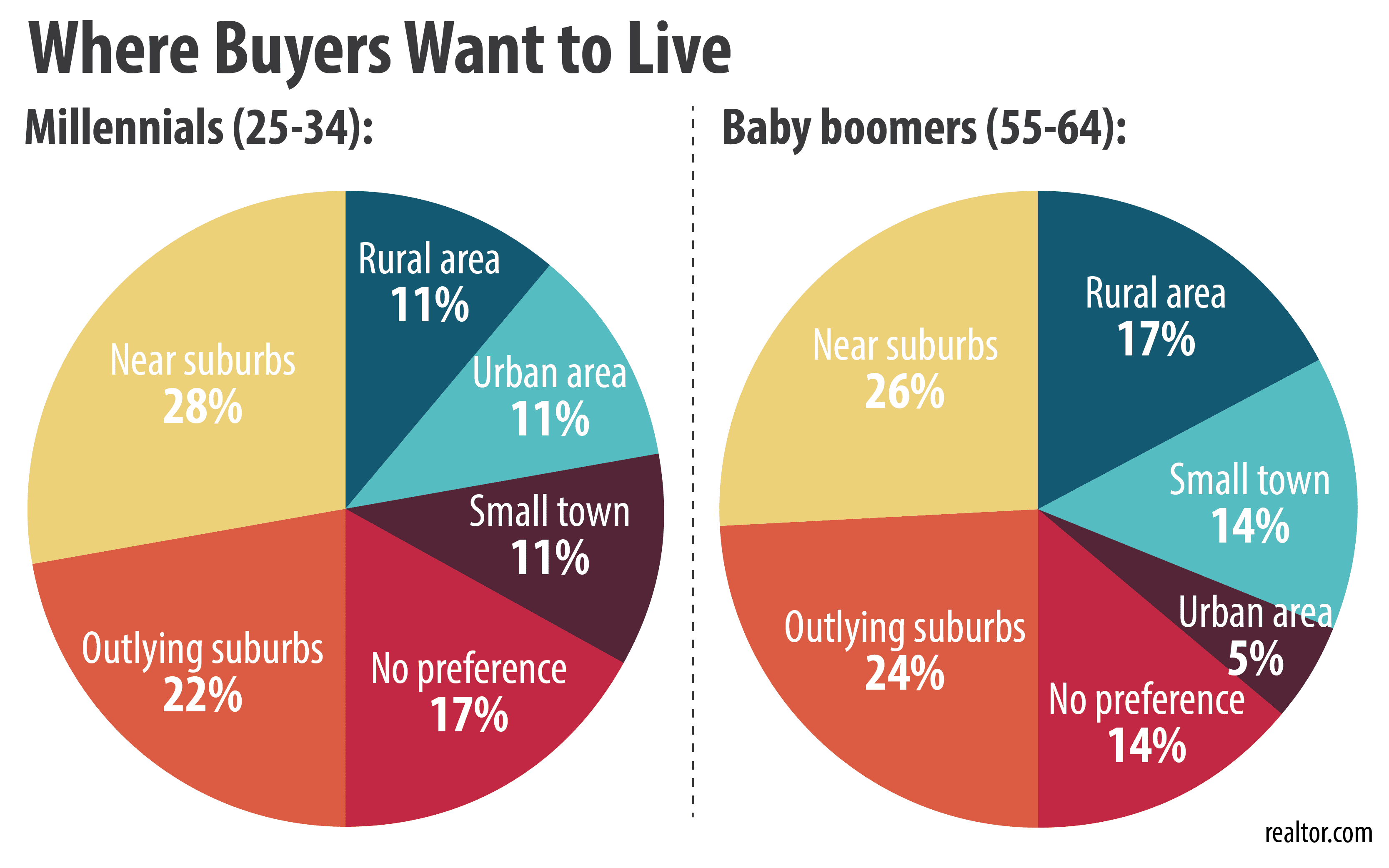
So, let’s see, where can you buy a big house with a yard in a safe neighborhood? You probably guessed it: the suburbs! First-time home buyers identify the suburbs as their No. 1 preferred location (43%). In fact, so do 50% of all respondents.


“The majority of home-owning Americans live in the suburbs, so the popularity of the suburbs isn’t a new phenomenon,” comments Smoke. “But the increasing preference by millennials represents a shift from the more urban locations where many of them have been renting.”


But that doesn’t mean our cities are going to empty out: Those urban areas are the second most popular option among millennials.


Meanwhile, baby boomers are also keen on the suburbs—either because they already live there and want to remain close to friends and family, or because they’re moving to another suburb where their adult children (and probably grandchildren) live.


shopper-03


By Ben Eisen


A month after the S&P 500 spawned a real estate sector, the new grouping is charting its own course.


For the first half of 2016, when real estate companies were still lumped into the financials sector, they were some of the year’s best performing stocks, climbing 8.7% even as the full sector fell 4.2%. But that began to shift in the second half, and since the new sector was created on Sept. 16, it has fallen 1.2% while financials have climbed 2%.


The reversal in performance illustrates just how different real estate stocks are from the financials category from which they were separated. It shows that in some respects, the stocks are polar opposites of each other.


“Real estate has a distinctive set of characteristics and deserves a seat at the allocation table,” said analysts at Wells Fargo Investment Institute, led by Chris Haverland, in a research note.


On the face of it, the decision to add an 11th sector to the S&P 500 may seem like little more than an administrative shift. The newest stock grouping in the benchmark index, and the first one to be created since 1999, makes up just 3% of its market value.


But creating a new real estate sector–and products to invest in it–allows investors to more cheaply and easily invest directly in those groups of stocks. Exchange-traded fund providers including Fidelity Investments and State Street Global Advisors offer ETFs tied to the sector.


One way to see the differences between the sectors is through correlations. Financials, excluding real estate, have had a 0.84 correlation with the broader S&P since 1990, meaning the two move closely together, according to Wells Fargo Investment Institute. Real estate, by comparison, had a much lower 0.55 correlation with the benchmark, the second lowest correlation after the utilities sector.
A correlation of 1 means they move by the same proportion in the same direction, while a correlation of zero means the two share no relationship at all.


The differing performance between the two sectors has largely been driven by the outlook on interest rates. As rates fell for much of the beginning of the year, high-dividend stocks like real estate firms out-performed because they offered comparably high annual income. Financials suffered because they were seen to be squeezed by lower interest margins from falling rates.


But in recent weeks, particularly since the sector split, investor expectations of a Federal Reserve rate increase this year are on the rise, sending benchmark bond yields higher. Financials have benefited while real estate has suffered.


Real estate includes real estate investment trusts and real estate management companies. Because REITS have special tax status, they are required to give at least 90% of their taxable income to shareholders. They often have higher dividend yields than the average stock. Wells Fargo describes the sector has having “traits of both equities and fixed income investments.”


Financials, on the other hand,  includes firms like banks, brokers, and insurance companies. Mortgage REITs are still included in the sector.

Higher rates don't mean the death of housing, says Blackstone's real estate chief


Concerns about the impact of what's expected to be higher Federal Reserve interest rates on the property market are overblown, Jonathan Gray, global head of real estate at Blackstone, told CNBC on Tuesday.


"We're later in the cycle, but some people are getting a bit too negative," said Gray, who manages $103 billion of investor capital — nearly a third of Blackstone's total assets under management. He controls more than $200 billion worth of real estate.


There's too much of a focus on rates, he said. "There's a [false] sense that owning real estate is the same as owning a bond."


"Real estate, like stocks, can see earnings growth," he argued. "And that's what we're seeing today because of favorable fundamentals."


In recent periods of rising rates — such as the early 1990s, the late 1990s and the mid-2000s — the property market "did OK," Gray said.


"We don't expect to see the growth in value in the next couple years that we've seen in the last four or five years," he admitted. "But we don't expect to see some sort of sharp decline in the near term."
Blackstone, a diversified investment firm with specialties in real estate and private equity funds, also has a major holding in Invitation Homes, a nationwide home rental company.


"The housing market is definitely a bright spot in the U.S. [economy]," Gray asserted, saying home building is not keeping up with demand and population growth. "The result of that is you're seeing rising rents and rising home prices. And we expect that to continue."


"We own about 100,000 either multifamily homes or single-family homes for rent. And across the board, across the country, we're seeing strength in that area," he said.

Tuesday, October 18, 2016

Your Buyers’ Nemesis:

Student Debt, High Rent


Student loan debt and high rental prices continue to sideline potential home buyers. More than half – 53 percent – of potential home buyers with student loan debt say the debt “somewhat” or “very much” is an obstacle to them in buying a home, up from 49 percent in 2014, according to the fourth annual housing survey from NeighborWorks America.


Read more: Student Loans Fuel Wealth Gap


“With the home ownership rate at the lowest point in decades, and minority home ownership plunging even further, these data signal a weak home buying market going forward, despite near record-low mortgage rates and broad-based national income growth,” says Paul Weech, president and CEO of NeighborWorks America.


Nearly 60 percent of renters say they went their next housing move to be into home ownership, according to the survey, but rising rental and home costs are delaying student loan holders from obtaining home ownership. A survey by the National Association of REALTORS® and SALT conducted earlier this year found similar results: Nearly three-quarters of non-home owners repaying their student loan debt say it is delaying them from a home purchase, and for many, that delay could be by more than five years.


Affordability concerns are growing. Fifty-six percent of those surveyed by NeighborWorks say they believe that rents in their area are too high for a person to save for a future home.


The study says that better awareness of down payment assistance programs and student loan debt counseling may help affordability. NeighborWorks found that 71 percent of Americans were unaware or not sure about down payment assistance programs. Further, 77 percent of those with student debt say they had never heard or were not familiar with loan counseling programs from nonprofits.


“These programs could help a consumer manage their student debt and provide information about down payment assistance programs that could increase the possibility of qualifying and obtaining affordable and sustainable home ownership,” according to NeighborWorks.


Source: NeighborWorks America

Mortgage Rates Move Higher This Week   


Borrowing costs are rising: The 30-year fixed-rate mortgage increased to a 3.47 percent average this week. Despite the uptick, rates still remain near historical lows.


"This week, the 10-year Treasury yield continued its climb as an increasing number of financial market participants foresee a December rate hike after a series of positive economic data releases," says Sean Becketti, Freddie Mac's chief economist. "The 30-year fixed-rate mortgage moved up 5 basis points to 3.47 percent in this week's survey, the first increase in one month. Even though we've seen economic activity pick up, consumer price inflation and implied inflation expectations remain below the Federal Reserve's 2 percent target."


Freddie Mac reports the following national averages with mortgage rates for the week ending Oct. 13:
  • 30-year fixed-rate mortgages: averaged 3.47 percent, with an average 0.6 point, rising from last week's 3.42 percent average. Last year at this time, 30-year rates averaged 3.82 percent.
  • 15-year fixed-rate mortgages: averaged 2.76 percent, with an average 0.6 point, increasing from last week's 2.72 percent average. A year ago, 15-year rates averaged 3.03 percent.
  • 5-year hybrid adjustable-rate mortgages: averaged 2.82 percent, with an average 0.4 point, increasing from last week's 2.80 percent average. A year ago, 5-year ARMs averaged 2.88 percent.
Source: Freddie Mac

You May Think It's Trash But It Could Be Treasure

Written by Connie Adair

Stephen Ranger walked into "one of the worst houses in the city" and found a rolled up blanket under the bed. The find -- a Second Phase Navajo chief's blanket worth more than $100,000, -- was unexpected. A find such as this is rare, says Ranger, vice-president of Waddington's Auctioneers in Toronto, but it does happen. So when you decide to downsize or purge, it's a good idea to call in an expert before you toss everything in the trash.

"There's never a downside to calling in a local auction house to do a quick walk through," Ranger says, adding a Waddington's expert costs $200 per hour. "It gives peace of mind."


"If you think something is worth money, chances are it isn't. If you think something is worthless, there's a possibility it may not be," says organizing company Downsizing Diva co-founder Karen Shinn. "Two sisters asked an antiques auctioneer to visit their house and look at their most valuable possession, a dining room set. It was the biggest thing in their house, they had spent the most money on it and used it for important times -- it had emotional value.


However the auctioneer told them it was worth about $400. Then he asked about the two vases sitting on the buffet. The sisters were going to donate them to a church yard sale. Those vases were Moorcroft," Shinn says.


Old magazines, postcards and even vintage cereal boxes are among the items people think are worthless but can actually have value, she says.


"When you're downsizing and want to make sure you don't get rid of valuable items, the best advice is to do your homework. There are a lot of resources out there -- the Internet, antique and art appraisers, books, senior move managers -- so check to make sure you have an idea what something is worth before you let it go. Items may have ‘heart value' to you and your family, but when you're talking about ‘dollar value' do your research."


If you have something that's been in the family a long time, you may want to have it checked out, Ranger says. "Send a photo to your local auction house." The auction house should give you feedback about whether it's worth auctioning or not.


Larger cities usually have qualified specialists working for established companies. "What you want to avoid is someone who comes in and scoops up that van Gogh in the closet," before you know what's happening, Ranger says.


However be prepared for the negative too. The value of most household goods has depreciated, he says. "The next generation doesn't collect like the last one.


Millennials are not collecting figurines or traditional furniture." That said, there are collectors for just about everything, antique, vintage, new and everything in between.


"Every fall when our crews go into homes during back-to-school season we come across valuable items that parents were ready to toss that are actually worth quite a bit of money to collectors," says Mike Thorne, president of St. Catharines, Ont.-based JustJunk.com.


JustJunk and Shinn have been in the business for 15 years each and put the knowledge they've gained over the years to work to help their clients spot treasures. It doesn't mean they'll catch everything of value, but a seasoned eye is an asset to your downsizing/purge project.


Here are some of the top kids' items with money-making potential that JustJunk tells parents to look out for when decluttering:


Pokemon: Pokemon Go may have taken the world by storm this summer, but there's plenty of money to be made from the original Pokemon for Nintendo Game Boy. Original game cartridges in good condition are selling to collectors for a few hundred dollars.


Polly Pocket: These tiny dolls and play sets that were popular in the early ‘90s can fetch $500 or more if they're in top condition.


Furbies: Launched in 1998, these strange owl-like robotic creatures are still highly sought after. Collectors will pay about $600 for one of these guys in mint condition - sometimes even higher if it's in the original packaging.


Harry Potter: If you happened to get on the Harry Potter train early and bought a 1998 first edition of the first book in the fantastically popular series - Harry Potter and the Philosopher's Stone - you could be in for a payday. Copies in great condition are currently selling for about $6,500 each. Add a signature from author J.K. Rowling and the price more than doubles to about $15,000.


LEGO: Some LEGO sets and mini figures can sell for hundreds of dollars to the right collector. Before getting rid of any LEGOS, it's a good idea to check online to see what's hot on the collectables market.


If you have the time and the inclination, you can search items on the Internet to get an idea of their worth. Consignment shops, selling items online and garage sales are ways to cash in on your unwanted items. But you have to gauge whether the time spent will be worth it.


When they are downsizing, people typically make three piles -- keep, donate and toss. Adding a fourth pile could make good financial sense.

Messing With The HOA Can Be Expensive

Written by


Most homeowners in a common interest development probably understand that it can be a real hassle to get into a dispute with the Homeowner Association (HOA). Not so many, though, may know that it can become pretty expensive as well. A recent case from California's Fourth Appellate District Court of Appeal makes the latter point abundantly clear. (Rancho Mirage Country Club Homeowners Association v. Thomas B. Hazelbaker et al., August 9, 2016) 

Thomas and Lynn Hazelbaker owned a condominium in the Rancho Mirage Country Club development. The development was subject to regulations and CC&Rs which were enforced by the Rancho Mirage Country Club Homeowners Association (Association). According to the Court record, here's what happened:


"In November 2011, defendants [Hazelbakers] applied for and received approval from the Association's architectural committee to make certain improvements to the patio area of their property. Subsequently, however, the Association contended that defendants had made changes that exceeded the scope of the approval, and which would not have been approved had they been included in defendant's November 2011 application.


"On June 19, 2012, the Association sent defendants a request for alternative dispute resolution pursuant to [Civil Code §5930], identifying the disputed improvements and proposing that the parties mediate the issue. Defendants accepted the proposal and a mediation was held on April 8, 2013. A ‘Memorandum of Agreement in Mediation' dated April 9, 2013, was reached … The agreement called for defendants to make certain modifications to the patio, in accordance with a plan newly approved by the Association… The agreement provided for the modifications to be completed within 60 days from the date of the agreement. It also provided for a special assessment on defendants' property to pay a portion of the Association's attorney fees incurred to that point…


"The modifications described in the mediation agreement were not completed within 60 days. The parties each blame the other for that circumstance."


On September 4, 2013, the Association filed a lawsuit seeking specific performance of the mediation agreement. Subsequently, the parties reached an agreement regarding the modifications, slightly different from those agreed to in mediation. Those modifications were completed in September 2014. However, the parties continued to have disagreements about who should bear the costs of litigation to that point.


On October 15, 2014 the Association filed a motion seeking attorney fees. The motion was based on Civil Code §5975(c) which is part of a large body of law, commonly referred to as the Davis -- Stirling Act, concerning common interest developments. §5975(c) says, "In an action to enforce the governing documents, the prevailing party shall be awarded reasonable attorney's fees and costs."
On December 2, 2014 the trial court issued an order granting the Association $18,991 in attorney fees, plus $572 in costs. The Hazelbakers appealed.


The central question for the Appellate Court was "…is a lawsuit to enforce an agreement that was reached during mediation (or another form of ADR) an action ‘to enforce the governing documents' in the meaning of section 5975, where the mediation was initiated pursuant to the Davis -- Stirling Act? And the Court's answer was "yes", at least in circumstances similar to this case. (The Court acknowledged that the answer might have been ‘no' had the mediation involved other matters.)


The Hazelbakers also questioned the amount the trial court had awarded. They should have been satisfied with what was assessed. The amount initially requested by the Association was $31,970. In any event, the Appellate Court upheld the trial court's figure of $18,991, noting that "It is well settled, however, that the trial court was not required to issue any explanation of its decision with regard to the fee award."


Finally, the Appellate Court noted that, as prevailing party in the appeal, the Association is entitled to recover its appellate attorney fees. That figure will be set by the trial court.


We don't know what the patio improvement itself cost; but we do know that you can add to that figure the Hazelbakers own attorney fees plus those of the Association.


This all started with a decision to depart from or modify the plans as approved by the Association. Typically, it would really be a bother to go back to the architectural committee and seek approval for the change. But it might have been a whole lot cheaper. Maybe there's a lesson there.


Bob Hunt is a director of the California Association of Realtors®. He is the author of Real Estate the Ethical Way. His email address is scbhunt@aol.com .

How Color Helps Sell Your Home

Written by Realty Times Staff


Yes! Just like curb appeal matters, the colors of your home can and will influence buyers. With that in mind, we explore which colors tend to appeal to the masses.


The color scheme of your home, from the outside in, sets the tone. It's like going to see a theatre play and seeing an intricately crafted and appropriately painted set for the production. It can immediately intrigue you–before the play has begun and even if you know few details about the play.


When it comes to color, be sure to consider the location. A peach-pink home in a retirement community might be okay, but that same color in an upscale, urban city may be unappealing to younger city dwellers.

The outside of your home is one of the largest areas potential buyers will see. So make your decision carefully and be sure to have a professional paint job done. If you choose white for the exterior, your home is likely to appeal to the masses, according to one study that indicated upwards of 40 percent of people liked white homes.

The great thing about a white home is you have plenty of options to make the home stand out by using an accent color for the trim. The downside is that white gets dirty very fast and shows it more than other colors. So before you list your home, make sure that you have a fresh coat of paint applied or pressure wash the exterior to bring back that newly painted look.


Also take into consideration the color of other homes on the block. Typically, white will not look out of place. However, if you had a purple home on a block where the homes are mostly beige and neutral colors, you'll get noticed but won't likely get the kind of attention you want.


Beige with neutral-colored trim is another popular color scheme. Both beige and white are safe exterior colors. They don't turn buyers off.

There's also been a trend to paint just the front door a deep, rich color like red. This may not be appealing to all. However, buyers would tend to overlook it because it's a simple change as well as one that can easily and cheaply be changed to the new buyer’s choice. As long as the colors look good together, this wouldn't necessarily turn buyers away.


The paint inside your home is equally important. In fact, one good tip for sellers is that if they can do nothing else, they should get some fresh paint up on the walls. The new paint helps showcase the home and gives it a new-home feel.


There are a wide variety of interior colors. Don't feel like you have to go with only beige. You can be a little more daring, using bold accent colors. Just make sure the paint colors you choose don't give a dark, closed-in feeling. Aim to create comfort, a sense of calmness, relaxation, and a place where family can unwind. Earth-tone colors convey this very well.


For a more chic and sophisticated look, interior designers often choose from the grey palette. A dark grey color can create a bold statement and attract the eye to a particular area.


Whatever colors you choose, remember that your aim is to appeal to the masses. Test the colors out first. Get opinions from the experts.


Your real estate agent has likely been in hundreds of homes and can offer you some very good guidance.

Thursday, October 13, 2016

Home Buyers Please Note and Seize the Opportunity: Prices likely to stay muted for the next 6 months


It is generally believed that prices of residential houses may indicate upward surge due to greater demand and good appreciation of the property. However, according to a recent survey conducted b Knight Frank consultant for FICCI, housing sales are predicted to remain stable or improve in next 6 months while price appreciation is expected to be muted. After some slow down in the real estate business lasting about previous 6 quarters, the prospects of better sales in the housing sector is quite bright. This trend is an affirmation and faith of the stakeholders for better future. The report credits the real estate with positive transaction in the preceding six months and the projections are also positive.


The demand for office space is increasing manifold. The residential segment of the real estate which was experiencing turbulent time for the last three years has also made a good turnabout in terms of recovering from the shop. The consultant also observed that there is a significant improvement in the sentiments for the residential sector. This is substantiated by the number of respondents with a positive outlook for this sector moving up substantially in 2016 especially in the sales volume.
 
The report further credits on the basis of the feedback, more than 95% respondents that the sales volume will either be at the same level or improve in the next 6 months. It is also mentioned that despite this good showing so far as sales are concerned the stakeholders are of the view that the residential prices will remain muted. According to the report that more than 60% of the respondents participating in the survey consider that the appreciation in residential price will continue to be the same or even worse by the end of the year.
 
Thus, the report of Knight Frank released by FICCI project a mixed scenario of cheers and some concerns. For more visit irxlive.com

Quick Question: What's The Right Price?


Written by


Important real estate questions can often be asked quickly —"What's the right sale price?" or "What's the right list price?"— however, the answers may take a while. A question may be simple to ask, but the answer is usually complex because real estate is complicated.


Even when the person answering is very familiar with the subject, arriving at the "right"— best fit, complete, and accurate — answer may first require asking questions of the quick-question asker, because: 

Context is vital: Asking these questions is necessary to clarify location, property type, relevant ownership details, time-frames (seller and buyer), current market, and on it goes depending on what the asker wants to understand and why. For instance, has the asker just started thinking about selling, is the property already listed, or is an offer pending?


Point of View is highly relevant: The questioner may be asking from their point of view, or asking about the other parties involved, asking for a friend or relative, asking out of curiosity…and on that goes. The questioner's perspective, which may be a buyer's, seller's, or professional's viewpoint, is linked to their intent in asking the specific person they chose to question. This intent is tied to their connection with and potential gains from the real estate in question.


Level of understanding is essential: The questioner's level of real estate knowledge and experience determines how a complex answer to a "simple" question should be framed for maximum understanding. The answer must take into account the asker's knowledge of the law, finances, the real estate industry, and related factors like vocabulary.


And all this must be processed quickly. The person asked is expected to respond almost immediately.
As a speaker, writer, and author, I am regularly asked: "May I ask you a quick question?" My answer is as quick as the question may have been: "Yes, of course. I'd be delighted, however, the answer may not be as quick as the question."


A quick question is often a closed question which grammatically begs a short, factual, even "yes or no" or "either or neither" answer. However, there can be a lot for the answerer (me in this case) to consider before beginning to formulate an answer. For instance here's a quick question I was asked recently:
"I have a quick real estate question for you, PJ," began Bill, a stranger who had heard I write this column. "Is it better to list a house at a lower price to entice buyers [into a bidding war] or set a price more compatible with what the hoped-for sale price might be?"
Yes…or no…or either…or neither. The answerer may have an opinion from past experience or a personal preference for the same reasons. However, the accurate answer to the question lies in transforming this general query into a specific response relevant to the asker — Bill in this case — and his intent in asking that question and in choosing me to answer it.

The general answer to Bill's general question? "That depends on how desirable to identified target buyers Bill's property is and whether there is a buyers' or sellers' market in that location." At the same time, Bill's goals regarding the sale are just as important to consider in choosing a marketing strategy for price — list and sale.


The specific answer for Bill's specific question would first involve collecting property and ownership details, then determining market conditions, then creating a marketing strategy that reflects Bill's goals. That's what real estate professionals do. One that is familiar with Bill's specific property and market, would have a knowledgeable answer for Bill. If this were Bill's listing professional, Bill would receive specific, high-level details regarding each pricing option, so he could make a confident decision about all aspects of price. Along with market data on actual sales, this information would include details regarding listings competing with Bill's for target buyer offers.


My answer to Bill — after he answered a few of my questions — was directed to what information and support he could expect to receive from the real estate professional he selected to sell his home. Bill had intended to use the "right" answer to his quick question to select a listing salesperson.


My quick answer concentrated on explaining how either strategy could work. However, I stressed that only a professional with local market knowledge and experience, could provide the information to help him see which alternative would achieve his goals. The question Bill really wanted an answer to was: "How do I identify and select the best real estate professional to sell my home and achieve my goals?" That's the quick question I answered. Bill told me the answer was exactly what he needed.


My Quick Question: Does this make you afraid to ask me or anyone else a "quick question?" It must not. Sorting out what you don't know about real estate will ensure your selling or buying success.


Real estate professionals are trained to answer quick questions and every other type, so ask away. Listen to the answers. You'll learn a lot very quickly.


Remember, there are no "stupid questions" in real estate, except those questions you don't ask and later wish you had.

Tuesday, October 11, 2016

SOUTH EUCLID, Ohio – An Ohio law that took effect Wednesday could cut the length of the foreclosure process for vacant homes from years to mere months.


That seems like a good thing for a state grappling with thousands of abandoned houses, which drag down the values of surrounding properties and act as magnets for crime. Yet Ohio's new fast-track foreclosure program isn't garnering universal support. While the mortgage industry touts the law as a model for other states to mimic, some housing advocates in Northeast Ohio are skeptical – and worried about legislative add-ons they fear will do more harm than help.


Nobody's arguing against the guiding principle: Pushing vacant properties through the court system more quickly will reduce the window for deterioration and increase the odds that empty homes will be renovated and reoccupied, saving money for taxpayers and lenders alike.


"We end up in this cycle where we're draining local resources to take care of these things. And there's no resolution," said Rep. Jonathan Dever, a Cincinnati-area Republican and attorney who sponsored the legislation. "We needed something to deal with these things."


Still, aspects of the law are chafing some researchers and public officials, who worry about the potential for eroded homeowner protections and lost local-government control. And even proponents of the legislation aren't sure how effective the fast-track program will be.


"We don't feel this is a terrific piece of legislation," said Sally Martin, housing manager for South Euclid, a heavily residential inner-ring suburb east of Cleveland. "Not at all."  The law doesn't apply to every foreclosure. Or to every vacant house.


To be fast-tracked, a home must carry a mortgage. The homeowner must be in monetary default – behind on payments – and have moved out. A lender then has the option, but not the obligation, to ask a judge for a streamlined foreclosure process and a swifter sale of the property.


The average mortgage foreclosure in Ohio takes 689 days, according to ATTOM Data Solutions, a California company that tracks the real estate market. That's almost two years. The fast-track program could reduce that wait time to less than four months for vacant homes through reducing paperwork, cutting down on hearings and putting firm timelines on parts of the process.


Hangover from the housing crisis


There are close to 80,500 empty or abandoned houses and condos in Ohio, based on a recent report from ATTOM, the new parent company of RealtyTrac. The state is among the nation's 10 most vacant, with no one living in 2.4 percent of homes.


Not all of those homes are in foreclosure, of course. During the third quarter of this year, ATTOM found, nearly 17,000 residential properties were going through mortgage foreclosure – a process initiated by a lender, distinct from tax-foreclosure proceedings kicked off by counties based on unpaid property-tax bills. Nearly 1,000 of those mortgage foreclosures were considered "zombie" properties – homes sitting empty and in limbo.


A detailed, citywide survey puts Cleveland's demolition need at roughly 6,100 properties. That's a big number, but it's not as bad as researchers expected.


"A foreclosure process, once you file, it can take two years, three years. I've seen four years that a property is sitting there," said Robert Klein, the founder and chairman of Safeguard Properties of Valley View, a major player in the business of securing and maintaining vacant homes for banks. "If a property is occupied, keep them there. I don't care how long it takes. ... Let them live there. But when a property becomes vacant, for the property to sit there for a long period of time, in my opinion, is absolutely a sin."


Klein is a proponent of fast-track foreclosure laws, which have been passed in a handful of states including Nevada, New Jersey and Illinois and are being considered in several others. He believes lenders will be more driven to pursue and complete foreclosures on vacant homes if they know that there's a truncated timeline and a chance to take back a home before it has been vandalized and devalued beyond repair.


"You take any lienholder who gets a property in foreclosure that's in halfway decent condition, they're not going to let it sit there and become a zombie property," Klein said. "It's not in their financial best interest."


Once a foreclosure lawsuit has been filed, the fast-track program gives cities the ability to intervene and ask a judge to speed things up if a lender is letting a case languish.


But the law doesn't require lenders to initiate foreclosure on vacant homes or to seek fast-track status for such cases. And it won't necessarily do much to address almost 3,600 bank-owned homes that currently are sitting vacant across the state.


"It's kind of like chipping away at an iceberg or eating an elephant," Dever said. "One bite at a time. It's not a silver bullet or a one-size-fits-all for everybody."

It's kind of like chipping away at an iceberg or eating an elephant. One bite at a time."
 
As Daren Blomquist, senior vice president for ATTOM, points out, Ohio has the third-largest pool of empty bank-owned properties in the country, after Florida and Michigan. And the state has one of the nation's largest inventories of empty homes owned by investors, including out-of-town buyers who swooped in sensing opportunities in the wreckage of the housing bust.


"Nobody's arguing that you should just let vacant properties sit forever," said Geoff Walsh, an attorney with the National Consumer Law Center in Boston. "But I think a more appropriate approach is to look at who caused the problem. Nothing in this Ohio legislation really addresses that. ... Have there be an enforceable law with meaningful sanctions at the state level that penalizes lenders that delay foreclosures and allow properties to deteriorate when they are abandoned. Generally, the lending industry has opposed that type of legislation."


Ohio's law doesn't include any such penalties for lenders, who have a financial stake in the homes as collateral for loans but don't actually control the properties. In some ways, the fast-track program seems more like a carrot than a stick. It provides incentives – speed, cost-savings and a potential financial upside – for banks, in hopes that they'll jump on the bandwagon.


The only punishment outlined in the law is for homeowners, who can be charged with a misdemeanor and fined if they willfully damage a house once the foreclosure process has started. That's the lending industry's response to cases where frustrated and angry residents have trashed – and even demolished – houses after receiving notice of a lawsuit.


Even Dever, who sponsored the legislation, expects that part of the law to be challenged.
"To me, that was one of the areas I wasn't so sure about, either," he said. "How can you be held responsible for doing that to your own house? It's a weird thing."


A foundation that could be modified


Parts of the law, wrapped into Substitute House Bill 390, are likely to be tweaked later this year or early next, Dever said. Those adjustments could come in the form of modifications to House Bill 463, the original fast-track proposal that's still live in the General Assembly.


Some county treasurers and housing organizations in the state are talking about possible amendments. They're particularly perturbed by changes to sheriff's sales, the public auctions where foreclosed properties are sold. The law creates the framework for a statewide website that eventually will replace the in-person sales held at county courthouses and other public buildings.


The website hasn't been designed yet and likely won't exist for another year, at least. There is a five-year phase-in period, so counties aren't immediately required to participate. And the law requires much more documentation about online bidders than local governments collect today. Right now, almost anyone with cash can walk in and buy a house, no questions asked.


Critics believe online listings and sales will encourage more far-flung speculators to snap up properties in Ohio, where out-of-state investors already own at least 3 percent of all single-family homes, according to estimates from ATTOM. County treasurers also are worried about a provision that delinquent property taxes don't have to be paid at the time of a sale.


But public officials including Martin, in South Euclid, are even more concerned about the change in minimum-bid requirements for auctioned properties.


In the past, foreclosures went up for auction at two-thirds of their appraised value, based on county valuations. If a house did not sell the first time, it went up for auction again at the same price. The home eventually might land in the hands of a local land bank, entities that focus on both demolition and redevelopment.


Under the new law, the second sale no longer has a minimum bid requirement. If a house doesn't sell the first time around, it could be offered up again at a much lower price.


"Housing advocates in Cuyahoga County are working on an amendment that would address one specific thing, and that's to restore the minimum two-thirds bid," said Frank Ford, senior policy advisor at the Western Reserve Land Conservancy in Cleveland and a leader of a local coalition of public- and private-sector representatives focused on vacant real estate. "Either do that, or when there's a property that does not sell at the first sheriff's sale for want of bidders, then that property should be offered to the local county land bank as a donation."


Dustin Holfinger of the Ohio Bankers League, which backed the fast-track legislation, said eliminating the bid threshold ultimately will help communities by getting empty homes into the hands of lenders who can resell or donate them or investors who could remake them.


He predicts that most homes won't even make it to a second auction. And he dismissed the idea that investors will be snapping up houses for as little as a $1 – a fear of community groups.


"This bill is probably seven years too late," said Holfinger, vice president of state government relations for the banking organization. "But at least it's occurring at this point. And we believe that it's important to avoid any digression back into the onslaught of vacant and abandoned properties that communities have faced."


Statewide standards versus local control


Dever attributed much of the consternation about the new law to confusion, driven in part by changes between early versions of the legislation and the ultimate language.


For example, the initial bill included a list of criteria for proving that a property is vacant, including trash on the lawn, broken windows, busted doors and disconnected utilities. The final iteration also requires corroboration from a local government representative, such as a code-enforcement official. If a lender doesn't have that proof at the outset, a judge has seven days to order the local community to conduct an inspection.


In South Euclid, that requirement will be an extra burden for already busy staff. But Martin, the housing director, is glad to have an additional layer of control. She worried early on that residents would be turned out of their homes based on visual evidence from lenders and the companies that banks hire to inspect properties.


"We wanted that language where a city can be the deciding factor," she said. "As much as that does provide work for a municipality, it's important work."

For every community that has healed — suburban Rocky River and Orange, or Cleveland's Ohio City and Tremont, to name a few — several are ailing. On some streets, buyers engage in bidding wars. On others, it's tough to get anyone to stop, look or make an offer.


Since the housing bust and the Great Recession of 2007 to 2009, South Euclid has slashed vacancy from more than 800 properties to just shy of 200 today, helped by a 2010 city ordinance that put a registration requirement and sale restrictions on empty buildings. Sellers must bring homes up to code or buyers must agree to take on the violations and commit to fixing them before a property can change hands.


It's clear that Martin is worried about anything that threatens her community's ability to shape what happens to abandoned homes. Faster foreclosures, a smoother sheriff's sale process and better documentation from bidders are all good, she said. But, to her, the new law still feels like it's more about aiding banks and less about fighting blight.


"We've had to take the cleanup of the foreclosure crisis into our own hands because nobody is coming to do that," she said. "The banks aren't bailing us out."
Race, School Ratings And Real Estate: A 'Legal Gray Area'


Kendra Yoshinaga  and
With her infant son in a sling, Monique Black strolls through a weekend open house in the gentrified Shaw neighborhood of Washington, D.C. There are lots of factors to consider when looking for a home — in this one, Monique notices, the tiny window in the second bedroom doesn't let in enough light. But for parents like Black and her husband, Jonny, there's a more important question: How good are the nearby schools?


It's well known in the real estate industry that highly rated schools translate into higher housing values. Several studies confirm this and even put a dollar figure on it: an average premium of $50 a square foot, in a 2013 national study.


In Chappaqua, N.Y., an affluent bedroom community for New York City, the town supervisor recently went so far as to declare that, "The schools are our biggest industry — whether you have kids in the school or not, that's what maintains our property values."


But some advocates for fair housing see a potential problem with the close ties between school ratings and real estate. They say the common denominator, too often, is race. And they argue that the problem has intensified in the last decade with new web platforms bringing all kinds of information directly to homebuyers.


"A school rating map mirrors a racial dot map," showing patterns of segregation and diversity, observes Sally Santangelo, the executive director of Central New York Fair Housing, a group that provides education and legal assistance to oppose housing discrimination.


That, in turn, raises some complicated questions about how factors like test scores and school ratings are used to influence homebuying decisions.


Characteristics like safety and parent involvement — the qualities Monique and Jonny say they value in a school— can be hard to quantify. Most states base their school ratings primarily on more easily measured factors, like standardized test scores and graduation rates. And these indicators, in turn, are heavily influenced by inequities of race and class.


There's a large, persistent and well-documented gap in test scores between black and Hispanic students and their white and Asian peers. There are many reasons for these disparities: income and wealth gaps, disciplinary policies that "push out" black students from school systems, less experienced teachers, the early-learning gap between high- and low-income children. But they all end up reflected in one number: a school rating.


"A lot of time, with schools that serve majorities of students of color, you get a negative rating because the test scores are low," says Genevieve Siegel-Hawley, an assistant professor who studies race and housing at Virginia Commonwealth University. But, she says, "most of the variation in test scores is explained by the kids' own poverty or the poverty of their school."


Housing patterns and school ratings, of course, also reinforce each other. In most places around the country, school budgets are partly linked to local property taxes. Highly rated schools beget higher housing values, which in turn beget more richly resourced schools.


It's a virtuous cycle for a town like Chappaqua, but a vicious cycle elsewhere.


What does all this mean for potential homeowners like Monique Black? Or for realtors who see school quality as a selling point?


For a realtor, directly discussing the racial composition of a neighborhood with homebuyers is against the law. In 1968, the Fair Housing Act outlawed the practice of racial "steering" by realtors. This can mean showing different properties to a white family and a black family who have the same requirements, or telling them different things about the desirability of a given property or neighborhood, in a way that tends to maintain segregation or perpetuate discrimination.


The National Fair Housing Alliance, an advocacy group, conducts "mystery shopper" sales tests, sending out people of various backgrounds to pose as house hunters and determine whether they hear different messages.


"A striking pattern regarding schools emerged from these sales tests," the report states. "Instead of making blatant comments about the racial composition of neighborhoods, many real estate agents told whites to avoid certain areas because of the schools. It is evident from the investigation that schools have become a proxy for the racial or ethnic composition of neighborhoods."


For example, white testers reported that they were told to avoid the Tarrytown, N.Y., schools, which are predominately Hispanic. In several cases, the report says, agents there told whites that the schools were "bad," but Latinos were told that the same schools were "good."


In Philadelphia, an agent told a white tester that the schools in a particular town were very good, then added, "But don't tell anyone I told you that."


Williams says comments about schools have been included as part of the evidence in at least one case that resulted in a finding of discrimination.


He points out that the National Association of Realtors advises its members not to air their opinions about schools, and to instead direct clients to objective sources of information.


House Hunting Online


Current fair housing laws govern advertising and statements made by landlords and real estate agents. But in the last decade, the web has brought the process of house hunting closer to consumers. And this brings a new dimension to the connection between racial housing patterns and school ratings.
Realty search engines like Zillow, Homes.com and Redfin link to local school ratings prominently on every listing. The actual racial and ethnic composition of each school is a click or two away. On all three sites these ratings are color-coded: green, yellow or red.


Siegel-Hawley of VCU started using Zillow when she and her husband were looking for a "dream house" in Richmond, Va. She quickly took note of the color-coded school ratings and said they reminded her of redlining, which was a legalized and explicit practice of discrimination supported by the Federal Housing Administration between 1934 and 1968.


The FHA published maps with poor communities of color shaded red, showing where they would refuse to insure mortgages.


The question Siegel-Hawley raises is: Might school ratings on real estate sites constitute a 21st century form of racial steering?


Redfin did not respond to a request for comment in time for publication.


Test scores are "a standard metric," says Nicole Hofmeister, a product manager at Homes.com. "To my knowledge, it doesn't factor in anything about race or socioeconomic factors."


Michael P. Seng, a professor of fair housing law at John Marshall Law School in Chicago, isn't so sure. Providing school ratings oversteps the bounds of what a real estate service should be doing, he says.


But to bring an actual court case, he explains, a plaintiff would need to prove that the school ratings steer people out of communities on the basis of race. "It would take a lot of statistical studies, but I think it's possible," he says.


Morgan Williams calls the issue a "legal gray area."


Current fair housing laws focus liability on the people who are selling housing: the landlords and the real estate agents. But online platforms put information directly in the hands of consumers, so their liability is less clear.


For example, in response to questions about school ratings, Katie Curnutte, vice president of communications at Zillow, offered this statement: "These data points serve as a starting point to do further research and connect with a real estate professional."


Sally Santangelo, of Central New York Fair Housing, agrees. "If you're just providing someone with neutral information," she says. "I think it would be hard to argue that the intent is discriminatory."
She adds that a homebuyer could easily access the same information about schools through other public sources, like local government websites. Plus, Santangelo says, "someone might want to move into a diverse community," and thus be using the school information for nondiscriminatory purposes.
But the use of color coding, and the ready availability of information about demographics, she says, could still be a cause for concern. "If a realtor was to hand somebody Census stats showing the race and ethnicity of the neighborhood, it would probably be an FHA violation."


The question that has yet to be settled, says Williams, is: "Does providing this information to consumers, in a format that would allow for discrimination, constitute discrimination?"


No, says Fred Underwood, director of diversity at the National Association of Realtors. "I'm not certain that any of this rises to the level where it would be a court case." On the other hand, he acknowledges, "If you're consistently undervaluing certain communities and overvaluing others, and there's a racial correlation, then there might be a problem."